
Hail Damage Roof Repair in Crowley, TX
Hail damage roof repair in Crowley, TX. Our roofers count the hits before anything is quoted.
From the driveway, a hail struck slope can look like nothing happened. Our roofers go up and count what actually came down.
Hail damage roof repair in Crowley, step by step
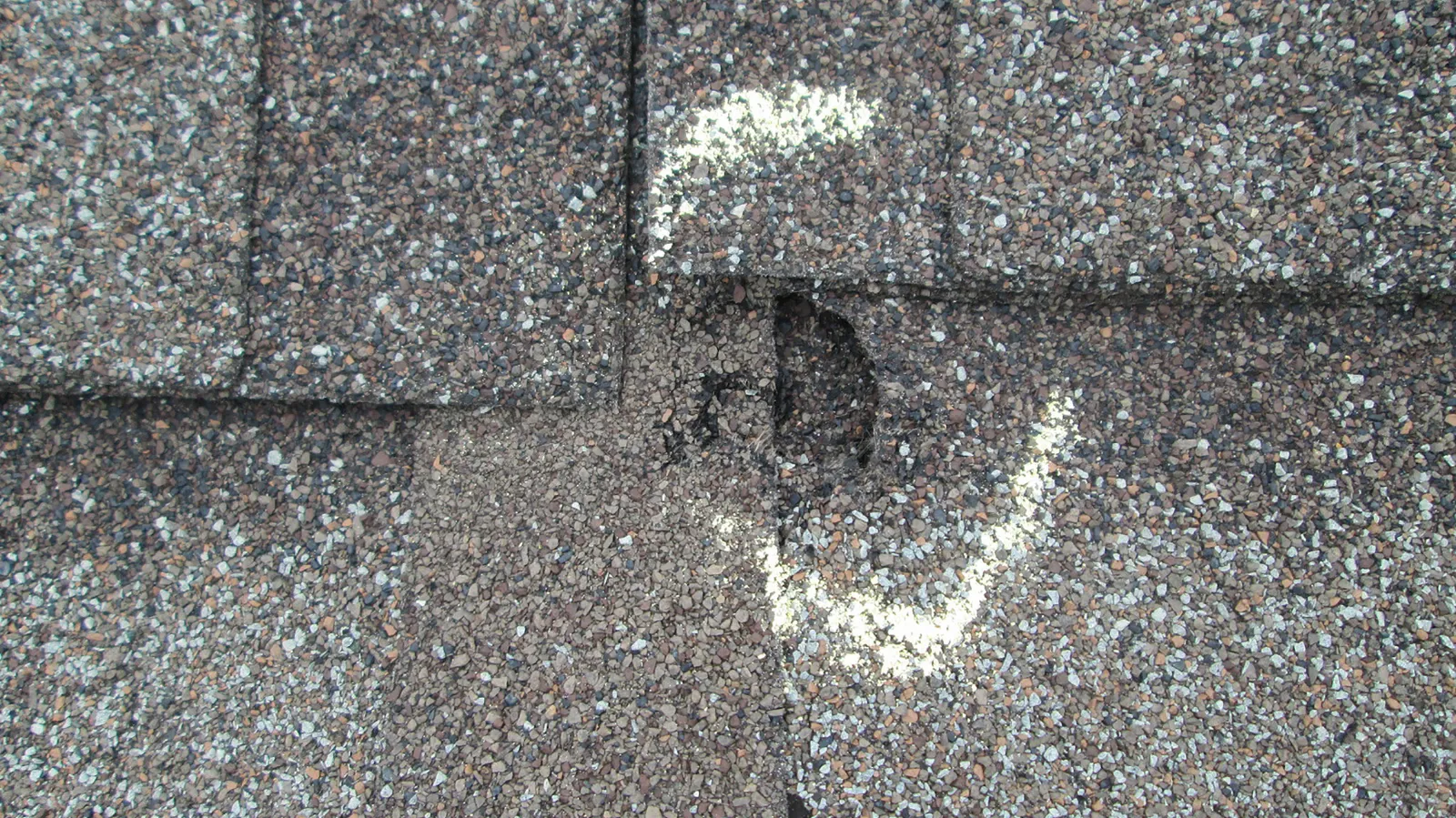
Why does a Crowley Roofing Co roofer chalk squares? Because the question is how many strikes are sitting on a slope, and a count needs edges before anybody agrees on a number.
The county hail record puts stones from quarter sized up to ping pong ball sized down on Crowley itself on June 1, 2025. That is not a reading of your slopes. A roof here can be carrying anything from nothing at all to a mat full of fractures, and that gap is too wide to settle from the yard.
A hail repair isn't one job either. Depending on what the count comes to, it is a handful of shingles and a new pipe boot on one face, a whole slope re-laid where the fractures cluster, or the full covering when every square comes back the same. Which of the three often turns on which slope took the storm.
Every slope marked
A chalked square goes onto each face of the roof, not only the one that took the weather head on. Two slopes on the same house often come back with very different counts, and a single square can't show you that.
The strikes counted
Every impact inside a square is counted, and the number is written down beside the slope it came off. Adjusters work from counts per square, so that is the shape the record has to be in before anybody argues about it.
Surface, then the mat
A strike that knocked the granules off may or may not have fractured the fiberglass mat underneath, and only the second one shortens the life of the roof. Telling those two apart happens by hand on the slope, mark by mark.
The roof's own metal
Valley metal, vent housings, the chimney cap and the drip edge dent at a smaller stone than a shingle bruises at, so they carry the clearest record of what size came down. They also fail on their own terms, which is why they are priced as separate lines.
Boots, curbs and seals
Pipe boots, skylight curbs and old satellite mounts are where a hail loosened roof tends to let water in first. Cracked boot rubber and lifted sealant go on the list whether or not the field around them counted high.
Ridge caps and vents
Cap shingles along the peak and the vents standing proud of the plane take hail at a worse angle than the flat of a slope does. They are also the two items a hail repair replaces most often, even where the field underneath holds up.
Where hail shows before the shingles do
Hail hits the whole property in the same minute it hits the roof, and most of what it hits is at eye level. Everything below is softer than a shingle, so it records a storm the roof itself can keep quiet about.
The window screens are pocked
Screens are the softest thing on the outside of a house, so they tear or dimple under a stone that leaves a shingle looking untouched. They sit on all four walls too, which makes them the quickest way to see which direction the storm came in from.
Pale spatter on the deck boards
Weathered wood and old paint carry a gray layer that hail knocks straight off, leaving pale marks where each stone landed. Those marks fade back within a few weeks, so a deck covered in them is telling you the storm was recent.
The gutter lip is dimpled
Gutter aluminum gives at a smaller stone than asphalt bruises at, so the outer lip picks up dents before the roof shows anything at all. Sight along the run from a corner of the yard and the dents break up the straight line of the reflection.
The siding took it at an angle
Siding, trim and window casings catch hail side on instead of square, so what they hold is shallow dings and spatter instead of round dents. The wall carrying the most of them tells a roofer which slope to start on.
The mailbox is dented
Thin painted steel out at the curb has nothing shading it, so it takes the storm at full size and keeps the dents where you can photograph them from the sidewalk. It stands clear of the house as well, so it tells you whether the hail was general or whether your trees caught most of it.
The condenser fins are flattened
Air conditioner fins are thinner than anything else on the property and they sit out in the open with nothing over them, so they take the full size of what fell. Flattened fins make the unit work harder as well, which makes this the one hail sign that turns up on a power bill.
Slope by slope, inside marked squares
The square exists so somebody who wasn't up there can still check the work. A number with a photograph behind it survives a conversation six months later, and a memory of a roof doesn't.
A roofer marks the square
Ten feet by ten feet, chalked onto the slope where the damage looks worst and again onto a face that looks clean. The clean square matters just as much, because the difference between the two is most of the argument.
The roofer counts inside it
Every mark inside the chalk gets counted, and each one is read for whether the mat underneath fractured or only lost granules. A slope with a few scattered scuffs and a slope peppered edge to edge are different jobs, and the count is what separates them.
The roofer shoots each square
The chalk, the marks inside it and something for scale go in the same frame, with the slope they came off named on the file. Those pictures are yours as much as anybody's, and they are what answers the question when somebody asks months later what was up there.
Your roofer writes up the work
The count decides the size of the job, and the order doesn't change with it. Your roofer takes the damaged material off, looks at the deck while it is open, lays the new shingle into the existing courses, and sets new metal at the edges. Only the length changes, and a single slope finishes well inside what a whole covering takes.
Your deductible is the number that matters
A full replacement here is figured on 26 squares, the planning size these totals assume. Most hail claims never touch every square, so the repair figure usually lands well under this.
The number people want has two parts, and only one of them is about the roof. Architectural shingle installs nationally at $450 to $690 per square, and a square is a hundred square feet of finished surface. Where a storm claim covers the work though, that band isn't what you pay; the deductible is, and the policy you already hold sets it. No roofer moves that figure, so read yours before deciding whether a claim is worth opening, because a one slope repair can come in underneath it and still be worth doing. What each covering costs is on the pricing page.
$450 to $690 per square · A national installed range for architectural shingle. Your own figure comes off a tape on your own roof, and a hail repair rarely touches every square of it.
National planning ranges, not a quote. Your roof sets the real number.
Hail questions from Crowley streets
Hail talk starts with the neighbors. These are the questions that follow, before anybody is on the roof.
Book the Crowley hail assessment
The chalk washes off in the first rain, the count stays on paper, and what you do with it afterwards runs on your own clock.