
Roof Insurance Claims in Crowley, TX
A roof insurance claim in Crowley, from the declarations page to the last payment.
Tell us what the storm did up there, and our roofers read it against what the policy covers.
Actual cash value against replacement cost
Somewhere in the middle of a claim, every homeowner finds out which kind of policy they bought. It decides more of what the roof claim comes to than the damage itself does.
Actual cash value
Actual cash value settles on what the covering was worth on the morning of the storm: the cost of a new roof, less depreciation for the years it had already worked. The carrier writes one payment, the deductible comes out of it, and the depreciated share does not come back.
Age is what bites here. Depreciation is figured against how much life the roof had already spent, so an older covering can settle a long way under what replacing it costs, and nothing releases that gap later.
Replacement cost value
Replacement cost value covers a like-for-like roof at what building one costs today, and it does not all arrive together. The carrier pays the depreciated amount first, less the deductible, and keeps the remainder back.
That remainder is recoverable depreciation, and the carrier releases it once the new roof is on and the closing paperwork has gone in. Stop after the first payment and the balance stays where it is, even though the carrier had already put a figure on it.
Which one you hold is fixed by the policy, and no roofer changes it.
A Crowley roof claim, stage by stage
What does a Crowley Roofing Co job look like when there is an insurance claim running alongside it? It runs in a set order, and nearly every stage of it depends on evidence gathered before the carrier ever looks at the roof.
Many policies carry a separate deductible for wind and hail, often a percentage of what the house is insured for instead of a flat figure. That percentage usually runs between one and five, which is why two neighbors with identical damage can owe very different amounts, and why some hail is not worth claiming at all.
The other thing a claim turns on is a date. A carrier is paying for damage from one identified event, so a claim with no storm behind it becomes an argument about wear, and the storms that have crossed Tarrant County are logged by date.
The date of loss
Every roof claim is anchored to one storm on one day, and that date is the first thing a carrier asks for. Damage with no event behind it reads as wear, and wear is what carriers exclude by default.
Notice to the carrier
You report the loss and the carrier opens a file with a claim number on it. That number becomes the reference for every document that follows, including whatever your roofer sends in.
The adjuster's inspection
An adjuster comes out on the carrier's behalf to look at the roof and decide what is covered and what it is worth. They are working for the insurer, and what they write down comes from what they can see that day.
The carrier's written decision
What comes back is the insurer's own estimate: approved, partly approved or denied, with the first payment attached if it is approved. That estimate is the carrier's version of your roof, and everything afterwards argues with it.
The work, and the supplement
The roof gets built once the scope is settled, and anything the first estimate missed goes back as a supplement. Your roofer documents those items with photographs and measurements so a short estimate can be corrected.
The final invoice
When the work is done your roofer sends the completion paperwork and the final invoice. Under a replacement cost policy that is what releases the held-back depreciation, so the claim is not finished until it lands.
Photographs, filing, then the adjuster
Each stage here makes the record the next one is judged on. The early ones decide what the later ones have to work with.
Your pictures come first
Whatever is already on your phone counts, and so does anything a neighbor caught. A carrier weighs dated pictures taken before any repair far more heavily than the same roof photographed afterwards.
You open the claim
The call to the carrier is yours to make, and the claim stays in your name the whole way through. Your roofer's part is the roof and the documentation; the claim itself never leaves your hands.
A roofer maps the damage
One of our roofers goes over every slope, the metal at each transition, and the attic where the evidence points inside. What is up there comes back as a dated record instead of a description.
The adjuster walks it with a roofer
The adjuster decides what is covered, and they decide it from what they can see that day. Our roofers walk that meeting with you and point out the bruising, the creased tabs and the lifted flashing while everybody is up there.
What carriers want to see on a roof
One question sits under everything an adjuster writes down: did a storm do this, or did the years? These are the marks that separate the two on a roof in this county.
Bruises you find by hand
Hail leaves soft spots where the granules are gone and the mat underneath has taken the hit. They show up as dimples under a thumb long before they show up from the ground.
Creased tabs along an edge
Wind lifts a tab, breaks the seal strip and drops it back with a crease across it. A crease is permanent, which is why an adjuster counts it as damage and not as age.
Granules in the downspout ends
The coating that protects asphalt washes off in quantity after a hailstorm and collects where the water leaves the gutter. A handful of grit at the splash block is a slope losing its surface.
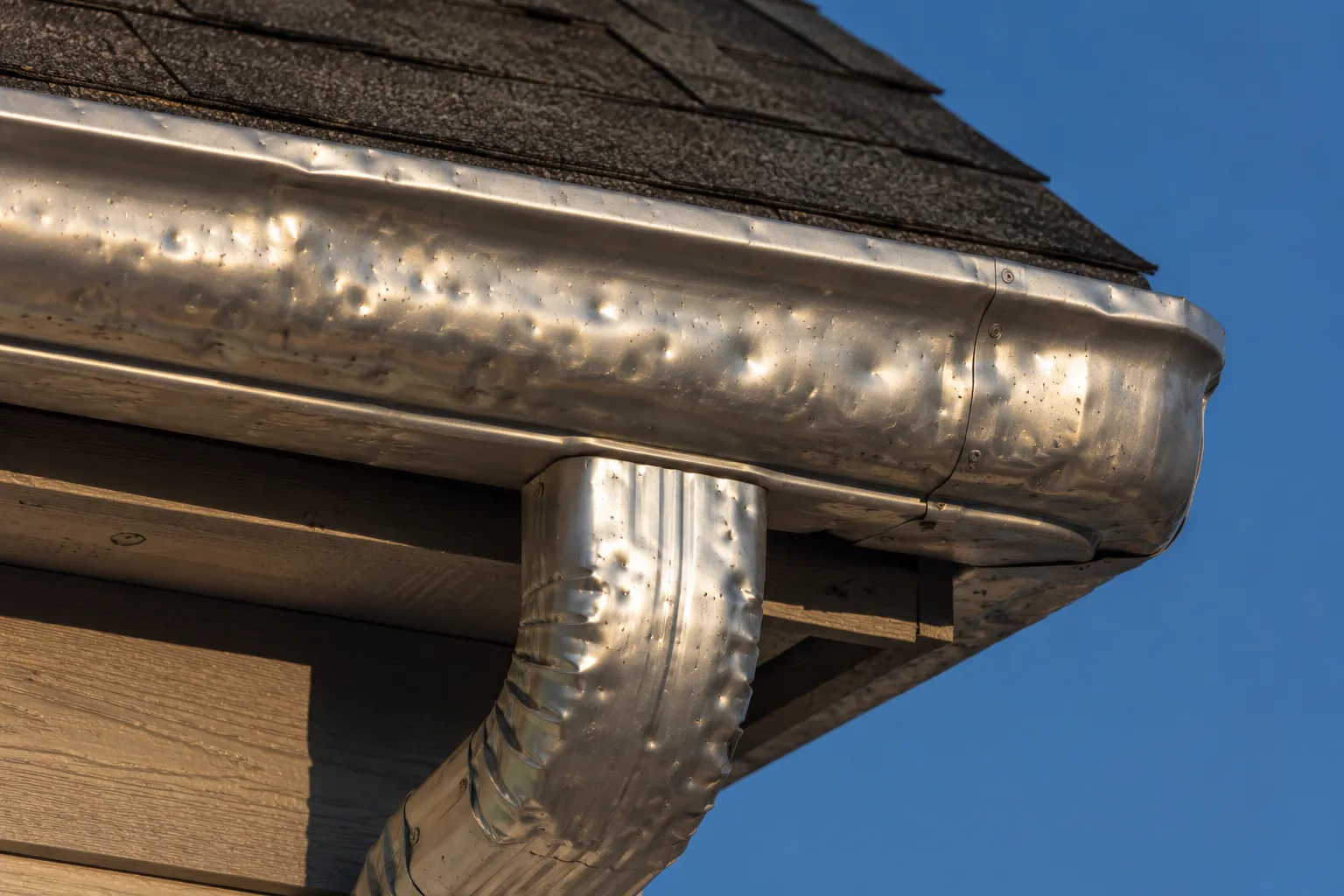
Dents in the soft metal
Gutters, vent caps, drip edge and air conditioner fins dent at the same size the roof took. Adjusters treat that as collateral evidence, and it often settles the argument about how big the stones were.
Damage on one side only
Weather crosses this county on a heading, so the slopes that faced it come out worse than the ones behind the ridge. Even wear across all four faces points at age; an uneven pattern points at a date.
Marks inside the attic
Wet decking, a rusted nail line or a stain on the sheathing tells the same story from underneath. When the evidence points inside, that is where a roofer looks next.
Claim questions after a bad night
What people want settled before they pick up the phone to a carrier.
Open the Crowley claim with evidence
Give the street and the date of the storm, and one of our roofers puts what is up on the roof onto paper before you decide anything about a claim.